
Leny J and Kai. Kai is my red merle Australian Shepherd. Born July 2024, 48 lb. Kai-tested means it’s in his bowl.
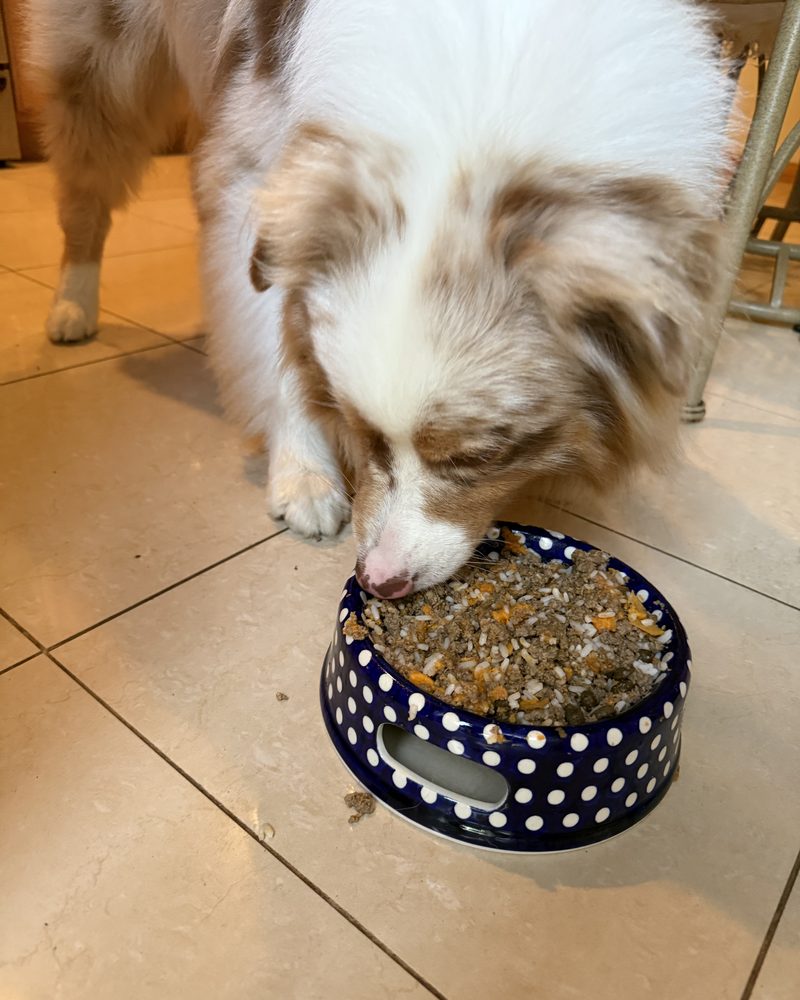
Kai’s bowl is a mix. I cook a plain base of lean beef, rice and sweet potato, and I mix ORIJEN Amazing Grains Six Fish into it. Amazing Grains Six Fish was his puppy food, and it’s still in his bowl today.
I want to be straight about what this page is. It isn’t a lab-tested recipe, and I’m not giving you amounts. What I can give you is what goes in Kai’s bowl, how to cook a plain base safely, and why a complete kibble stays in the mix.
That last part matters most. A homemade base is not a complete diet on its own. Researchers at UC Davis found that almost every homemade dog food recipe they tested fell short on at least one essential nutrient. So if you cook for your dog, have your vet check the recipe.
What’s in Kai’s bowl
Four things, nothing fancy. Here’s each one, and what to know if you cook it yourself.
Lean beef
Beef is the protein in the cooked base. If you use ground beef, USDA lists 160 °F as the safe minimum internal temperature for ground meats. Check it with a food thermometer. Cook it plain, with no seasoning.
Rice
Rice goes in cooked in plain water. Skip the salt and the butter. The ASPCA warns that excessively salty foods can make pets sick, and that milk and other dairy can cause diarrhea or other digestive upset.
Sweet potato
Sweet potato goes in cooked and soft. Cook it until a fork slides through, let it cool, and keep it plain like everything else in the base.
The kibble that rounds it out
The fourth part is ORIJEN Amazing Grains Six Fish. ORIJEN formulates it to meet AAFCO nutrient profiles, so it’s a complete food on its own. The cooked base is not. More on why that matters below.
How to cook a plain base safely
This is general food safety, not a recipe card. I’m not listing amounts, because the right amounts depend on your dog, and that’s a conversation for your vet.
- Use a food thermometer. USDA’s safe minimum for ground meats is 160 °F.
- Keep it plain. No salt, butter, sauces or seasoning blends.
- Never add onion, garlic or chives. The ASPCA says they can cause red blood cell damage that leads to anemia, and dogs are at risk depending on the amount eaten.
- Never add grapes or raisins. The ASPCA says they can lead to kidney damage in dogs.
- Cool it fast. USDA suggests dividing large amounts into shallow containers so food gets down to 40 °F or below quickly.
- Refrigerate leftovers within 2 hours of cooking. USDA says leftovers keep 3 to 4 days in the fridge or 3 to 4 months in the freezer.
- Throw out anything left at room temperature for more than 2 hours, or 1 hour when it’s above 90 °F.
Those USDA numbers are written for food in general. They’re a good habit for a dog’s cooked base too.
Why a complete kibble stays in the bowl
This is the most important section on the page.
In 2013, a UC Davis team led by Jennifer Larsen, with Jonathan Stockman, looked at 200 homemade dog food recipes from 34 sources, including vet textbooks, pet care books and websites. 95% of them came up short on at least one essential nutrient, and more than 83% had several shortfalls. Even recipes written by vets usually had at least one gap.
The advice from the study was clear. Larsen said owners should avoid general recipes from books and the internet and consult a board-certified veterinary nutritionist instead. Only four of the 200 recipes were written by board-certified veterinary nutritionists, and all four had acceptable nutrient profiles for adult dogs.
A simple base like Kai’s can have the same kinds of gaps. The shortfalls the researchers called out included choline, vitamin D, zinc and vitamin E. You can’t see any of those in a bowl.
The researchers also found that 92% of the recipes had vague or incomplete instructions, and 85% gave no calorie information or didn’t say what size of dog they were meant for. That’s a good reason to be careful with any recipe you find online, this page included.
The study also found that rotating recipes for variety isn’t likely to fix gaps that many recipes share. That’s why there’s a complete kibble in Kai’s bowl, and why I tell anyone cooking for their dog to have their vet check the recipe.
ORIJEN Amazing Grains Six Fish, the kibble in Kai’s bowl
This is the kibble I mix in. Amazing Grains Six Fish was Kai’s puppy food, and it’s still in his bowl today. Check the name on the bag before you buy. ORIJEN also sells a grain-free recipe with a similar name, and that’s a different food.
ORIJEN lists at least 38% crude protein and at least 16% crude fat. The fish are salmon, herring, whiting, rockfish, flounder and cod, and the grain blend includes oats, quinoa and chia. The AAFCO statement covers all life stages, except growth of large size dogs (70 lb or more as an adult).
The drawbacks: it’s rich, so switch slowly and watch the stool. And it costs more than most kibble.
If you feed kibble only, or want other options, I compared ORIJEN with five other foods in my best food guide for Aussies.
As an Amazon Associate and Chewy affiliate, we earn from qualifying purchases. The price you pay doesn’t change.
How much to feed with a mixed bowl
I’m not going to give you Kai’s amounts. Every dog is different, and a mixed bowl makes the math harder, not easier.
Start with the feeding table on the kibble bag for your dog’s weight. That feeding table assumes kibble is the whole meal. Once you add a cooked base, the kibble share has to come down, and by how much is a question for your vet.
Then watch body condition. You should be able to feel the ribs without pressing hard and see a waist from above. Too padded, cut back a little. Ribs showing, add a little. There’s more in the how much to feed section of my food guide.
While you’re at the vet, ask about an MDR1 test if your Aussie hasn’t had one. It’s a gene some Aussies carry that changes how they handle certain medicines.
Optional add-ins
Pumpkin
Some owners add plain pumpkin as a topper. I wrote a separate page on Nummy Tum Tum pumpkin if you want to read more. Check with your vet before you add anything new.
What never goes in the bowl
These come from the ASPCA list of people foods to avoid feeding pets.
- Chocolate, coffee and caffeine. They can cause vomiting, diarrhea, abnormal heart rhythm, tremors and seizures.
- Xylitol. A sweetener in gum, candy, baked goods and toothpaste. It can cause low blood sugar and liver damage.
- Onion, garlic and chives. Red blood cell damage and anemia.
- Grapes and raisins. Kidney damage.
- Macadamia nuts. Weakness, vomiting, tremors and overheating.
- Alcohol and raw yeast dough. Dough can rise in the stomach and cause dangerous bloat.
- Raw or undercooked meat, and bones. Bacteria like Salmonella and E. coli, plus the risk of injury or blockage from bones.
If your dog eats any of these, call your vet or ASPCA Animal Poison Control at (888) 426-4435.
What this bowl won’t do
It won’t stop shedding. It isn’t a lab formula, and I don’t treat it like one. It isn’t a reason to skip vet checks. And it isn’t a treat plan. Treats are separate, and I cover them in my guide to training treats for Aussies.
If you’re setting up the basics, start with the Owner’s Kit. Everything else on feeding is on the food hub.
Questions Aussie owners ask
Can I feed my Aussie homemade food?
You can, but a homemade base on its own is unlikely to be complete. A 2013 UC Davis study found 95% of 200 homemade dog food recipes were short on at least one essential nutrient. Have your vet check any recipe, or work with a board-certified veterinary nutritionist. Kai’s bowl mixes a cooked base with a complete kibble.
What’s a good homemade recipe for an Aussie?
One that a board-certified veterinary nutritionist has checked for your dog. The UC Davis researchers advised against general recipes from books and the internet. Kai’s base is plain lean beef, rice and sweet potato with ORIJEN Amazing Grains Six Fish mixed in, and I don’t publish amounts.
Do I need supplements with homemade food?
Only your vet or a veterinary nutritionist can say, because it depends on the recipe. The UC Davis study flagged gaps in nutrients like choline, vitamin D, zinc and vitamin E. That’s one reason Kai’s bowl includes a complete kibble.
How much homemade food should an Aussie eat?
There’s no single answer. Start from the kibble bag’s feeding table for your dog’s weight, remember that a cooked base changes the total, and set the split with your vet. Then adjust by body condition. You should be able to feel the ribs without pressing hard.

I’m Leny, and Kai is my Australian Shepherd, the reason there’s dog hair on every floor of my house. This site is the gear and food Kai actually uses, with what worked for us and what didn’t, so you can spend less and get it right the first time.