
As an Amazon Associate we earn from qualifying purchases.
Give your teething Aussie puppy a soft, puppy-specific chew toy, not a hard bone or antler. PDSA says it should give under your fingernail and be too big to fit completely in your puppy’s mouth. For a cold option, AKC suggests a food-stuffable puppy toy filled with mushy kibble or broth and frozen.
Kai has used the HOPET lick mat; this isn’t a first-hand teething test.
What KONG says about puppy toys
KONG’s own guidance points to its softer Puppy rubber for developing teeth and gums. Its Puppy product page says the line is designed for teething and is not recommended for puppies over nine months. Choose by your puppy’s current weight, not the adult size you expect them to reach.
KONG’s Puppy page lists each size by weight, starting at X-Small up to 5 lb and Small up to 20 lb. Treat those bands as a starting point, not a size rule for every Aussie. Ask your vet about the fit and firmness for your puppy.
Pick this if
- Your puppy wants to gnaw: choose a puppy-specific chew that suits their mouth and chewing strength.
- Your puppy wants to lick food: a lick mat does that job, but it does not replace a chew toy.
- Your puppy tears pieces off toys: ask your vet what suits that chewing strength and stay nearby during use.
When Aussie puppies lose their baby teeth
VCA says baby teeth usually finish coming through by about six weeks. They begin falling out around 12 weeks as adult teeth come in, with the change normally complete by six months. That is general puppy guidance, not a separate Aussie timetable.
Chewing does not stop just because the adult teeth arrive. VCA explains that dogs also use their mouths to explore and keep chewing to some degree throughout life.
What I’d skip for teething
- Bones, antlers and hard nylon: VCA warns that hard objects can break baby and adult teeth and advises against anything that won’t bend.
- Rawhide: PDSA advises avoiding it because swallowed pieces can cause a blockage, among other risks.
- Rope and stuffed toys as ongoing chews: PDSA says these are not chew toys, and swallowed rope or stuffing can cause gut blockages.
- A toy that fits completely inside the mouth: follow PDSA’s fit guidance rather than choosing by age alone.
For edible chews, ask your vet before choosing one. AKC says suitability depends on the puppy, while VCA describes choking and obstruction risks with animal-part chews.
Keep the cold-food routine simple
- Choose a puppy-specific food toy that permits freezing, and check the size and firmness with your vet.
- Use AKC’s mushy kibble or broth suggestion as a starting point, and ask your vet about suitable food for your puppy.
- Stay nearby while your puppy uses it, even if it is a recommended toy.
- Check it for damage before offering it again and stop using it if it is damaged.
When hands and furniture become chew toys
PDSA recommends redirecting your puppy to an appropriate toy and praising them for chewing that, rather than punishing. AKC recommends teaching “drop it” with a trade instead of making the stolen object into a chase.
Move shoes, cables and other tempting items out of reach. AKC stresses supervision even in a puppy-proofed home.
Lick mats are a separate food activity
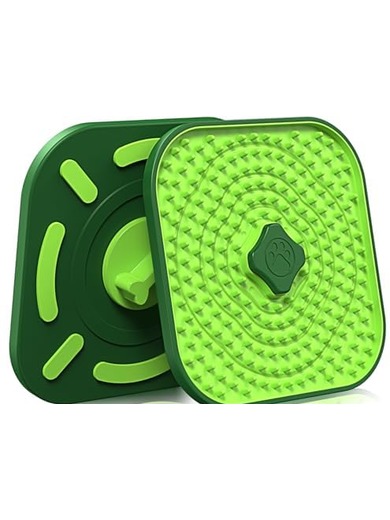
The HOPET mat holds food for licking. It isn’t the teething chew in this guide. If your puppy starts gnawing the mat, take it away rather than letting it become a chew toy.
| Activity | What to use | What to check |
|---|---|---|
| Teething chew | Puppy-specific soft chew toy | Fit, firmness and chewing strength |
| Food licking | HOPET square mat | Listing says all ages; no puppy-specific weight band |
HOPET square lick mat
Kai-tested
The listing describes a detachable crate-mount knob and freezer- and dishwasher-safe use. It says all ages, but gives no minimum puppy age or puppy-specific weight band.
Our kit routine is a thin smear of food, let the dog work the grooves, then put the mat away.
When to ask your vet
Ask about chew selection at your puppy visit. VCA says a little red staining on a toy can happen when baby teeth fall out, but retained baby teeth beside adult replacements need veterinary attention.
If chewing suddenly changes or becomes excessive, PDSA recommends a vet visit to rule out a medical cause.
Common questions
When do Australian Shepherd puppies finish teething?
VCA says baby teeth begin falling out around 12 weeks and adult teeth are normally through by six months. That is general puppy guidance, not an Aussie-specific schedule. Chewing can continue afterward.
What does KONG recommend for teething puppies?
KONG points to its softer Puppy rubber for developing teeth and gums. Its Puppy page says the line is not recommended over nine months. Choose by current weight and individual fit rather than expected adult size.
Can a lick mat replace a chew toy?
No. The HOPET mat is a food-licking surface, not the chewing option here. Supervise use and remove the mat if your puppy starts gnawing it.
Are antlers and hard nylon good teething chews?
VCA advises against hard objects, including antlers, bones and hard nylon, because they can break teeth. PDSA recommends chews soft enough to indent with a fingernail.
For other play ideas, see our Australian Shepherd toys guide. The HOPET lick mat is also on our kit page.

I’m Leny, and Kai is my Australian Shepherd, the reason there’s dog hair on every floor of my house. This site is the gear and food Kai actually uses, with what worked for us and what didn’t, so you can spend less and get it right the first time.